Founder, TerraSTOMEL · AI product builder · Model evaluator
I build LLM products with AI coding agents, and I evaluate whether they work.
STOMEL is the evidence: an AI-powered biological field instrument for iPhone, the first from TerraSTOMEL, that I specified, tested and took to TestFlight in five months. AI agents wrote the code. I owned the specification, the evals, the telemetry and every release decision.

01 Summary
I took an LLM product from first commit to external testing by directing AI agents, and I measured it the whole way
- 1
Shipped
A React Native client, a Node server and two production models, live on TestFlight with invited testers. More than 900 commits and 199 regression suites.
- 2
Measured
p50 reply 1.7 s, p95 3.8 s, about $0.0013 per exchange. Every model call is priced and timed in Founder Lab, the internal console I built.
- 3
Evaluated
Model and prompt changes are decided on small, targeted evals. A three-photo eval moved vision to a model that was faithful, nearly 4× faster and about 14× cheaper.
- 4
Still open
Cross-session recall is not reliable yet, there is no CI pipeline, and there is no prompt-injection suite. Each has a defined next step.
02 Why STOMEL
Most people never learned to tend living things beside someone who had, so I built an instrument that walks beside them
I have spent 25 years keeping living systems alive for a living: fish hatcheries, insect, yeast and algae protein, a ten-year edible-flower farm. The knowledge that saves a crop is rarely written down. It is learned from loss, usually standing next to someone who has already lost one.
Most people today did not learn cultivation from their grandparents, and most have never lost a crop and learned from it. The lineage is broken. STOMEL is my attempt to carry that lineage in an instrument: one that reads the conditions where you actually grow, remembers what happened to you, and helps you notice what the field is already saying.
It was built the opposite way from most consumer apps. It does not chase attention, streaks or engagement. It earns its place each day by being useful, and it is designed to be needed less as you get better.
“A steward should never leave thinking, ‘That AI remembered something.’ They should leave thinking, ‘Someone has been walking this journey with me.’”
From The Purpose of STOMEL, the founding note I wrote in August 2026
Failure counts for more
A plant that lived might have lived for many reasons; one that died failed for a specific reason. The ledger weights losses 3 to 5 times heavier than wins.
It becomes yours over seasons
On day one it is a general field instrument. After two seasons of your wins and losses, it knows your ground better than anything else could.
Success is needing it less
Success is measured by what you begin to notice for yourself, not by what the app knows.

TerraSTOMEL
The company I founded for what comes after STOMEL. A gardener, a shepherd, a beekeeper and a fish farmer run the same loop: something alive, in a place, under pressure, leaving a mark to remember. TerraSTOMEL carries one way of paying attention onto each new kind of ground. The name and site are secured; STOMEL comes first.
STOMEL
The first instrument: plants, soil and the green that grows from them. stomel.org
Aquaculture
The likely second instrument, drawing on my years running hatcheries and aquaculture research.
More living systems
Livestock, hydroponics, mycology and beekeeping: same approach, new vocabulary.
The substrate changes. The seeing carries.
Source: The Purpose of STOMEL (August 2026), the TerraSTOMEL founding brief and terrastomel.com
03 The product
STOMEL pairs an on-device plant-state model with an LLM that reasons over the grower's own records
The first TerraSTOMEL instrument, and an AI-powered biological field instrument: it reads living systems alongside the person tending them, remembers what actually happened, and says when it does not know.
Plant state
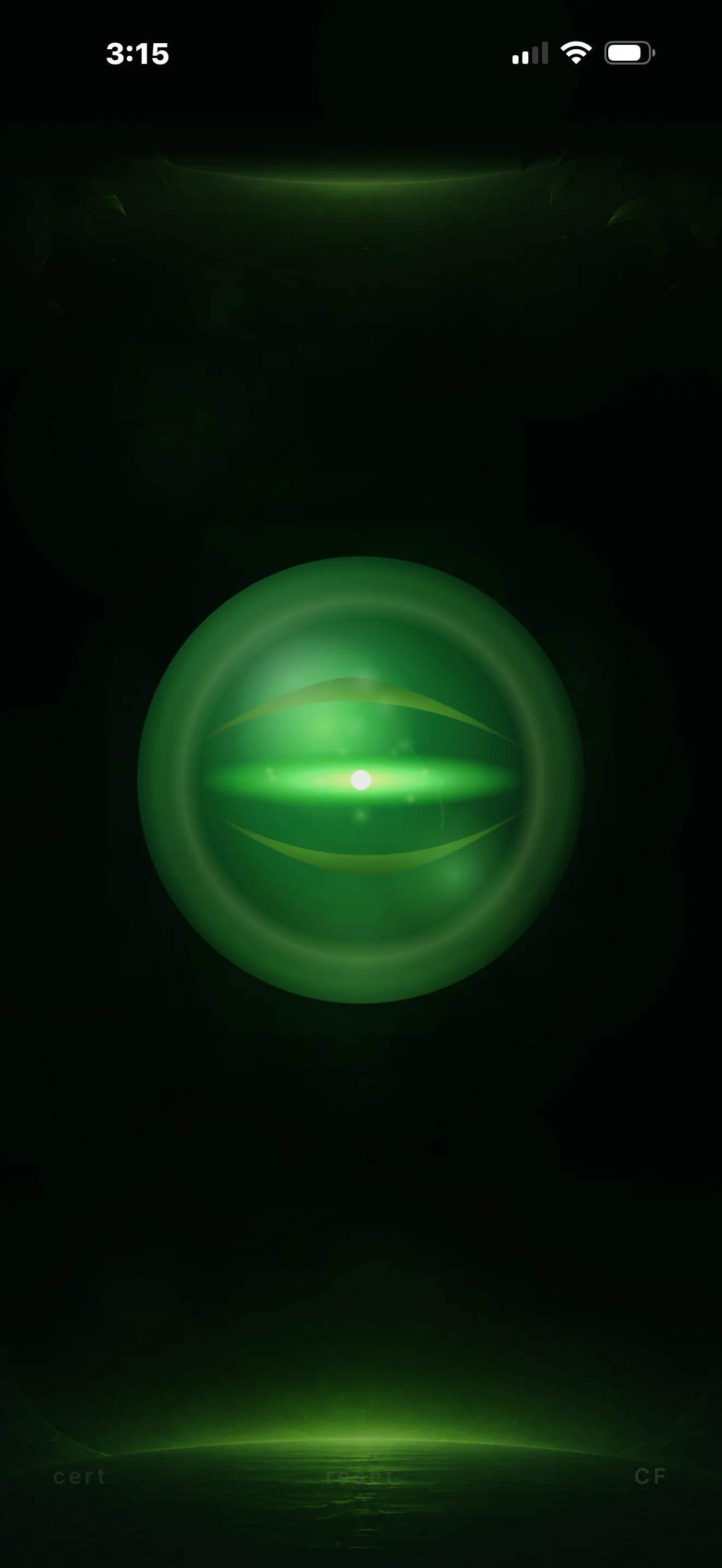
Local weather feeds a rules-based state machine with 11 plant states, computed on the phone. The interface renders the state as the stoma's breath, glow and halo.
Conversation
DeepSeek V4 Flash streams replies grounded in the grower's journal, a ledger weighted toward past failures, and the grower's own standing requests.
Design goal
No settings screens; the grower talks and the runtime adapts. Success means the grower needs the app less as their own observation improves.
A conventional stack, instrumented for latency, cost and safe rollback
| Layer | Implementation |
|---|---|
| Client | React Native 0.81, Expo SDK 54, Expo Router; SQLite journal on device |
| Server | Node and Express on Render, deployed from main |
| Data | Supabase with Sign in with Apple and row-level security |
| Models | DeepSeek V4 Flash for chat and background jobs; Gemini 3.1 Flash-Lite via OpenRouter for vision |
| Operations | Founder Lab for runtime model switching and per-call cost telemetry; 15 kill switches; per-route rate limits |
Source: STOMEL client and server repositories, November 2026
04 Founder Lab
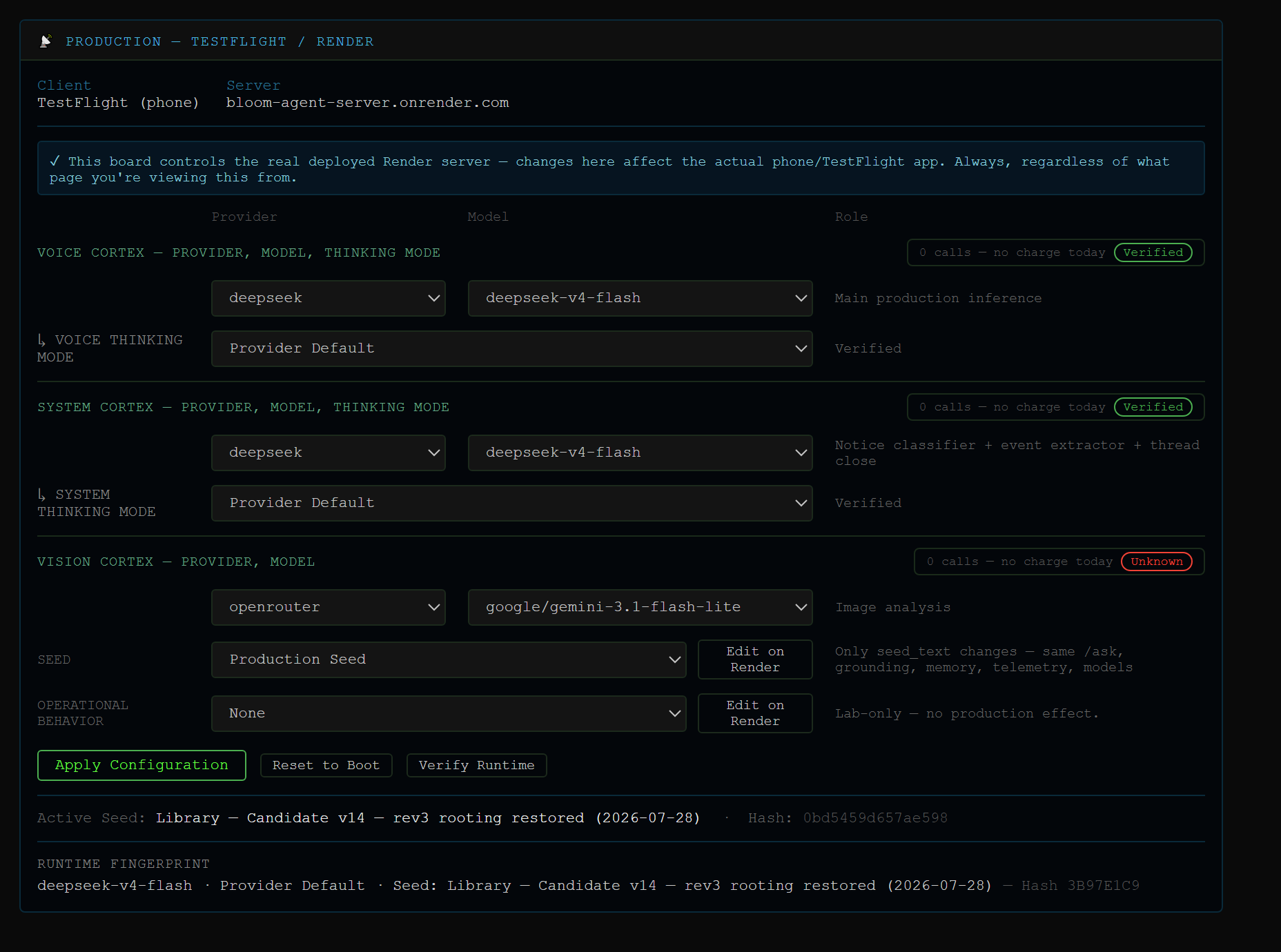
Founder Lab, the internal console I built, controls production models at runtime and prices every call
It is how the product is operated: which model handles each role, which prompt version is live, what each call costs and how long it takes, and whether a change made things better or worse.
Two screens from the production server
Production switchboard: provider, model and thinking mode per role, with the live prompt version and a runtime fingerprint
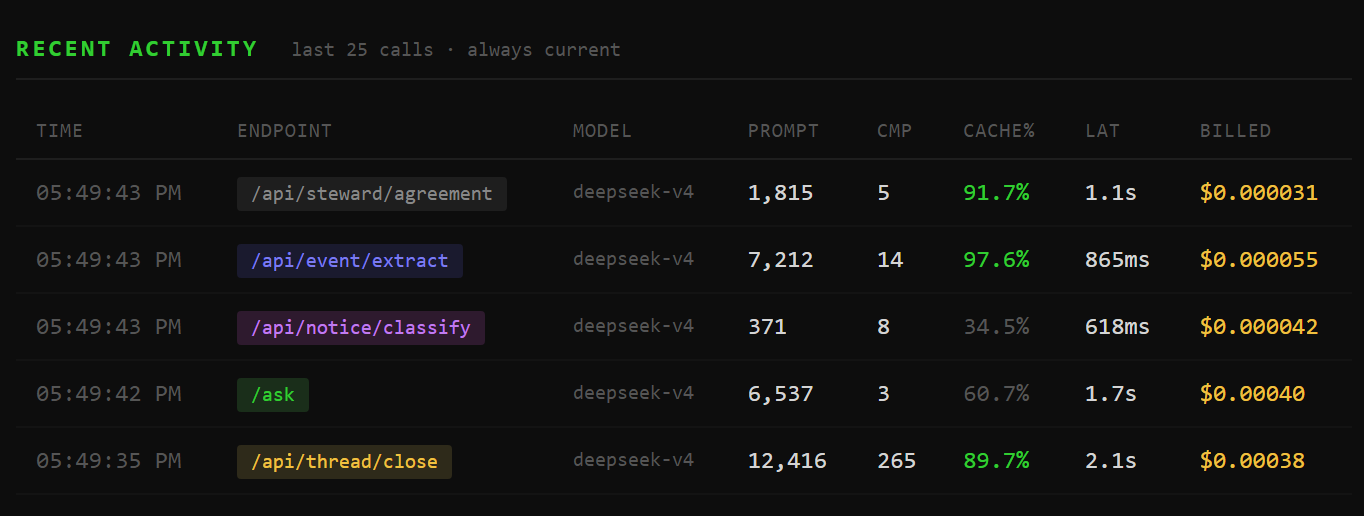
Telemetry: one real exchange. The reply, then four background calls, each with tokens, cache hit rate, latency and billed cost
Source: Founder Lab and telemetry console on the production server, captured November 6, 2026
05 How I build
AI coding agents write the code; I own the specification, the tests and the release decision
Agents used: Claude, GPT, Grok, GLM, Kimi and others. Every fix and feature follows the same six steps.
Three controls keep agent work honest
| Control | What it prevents |
|---|---|
| Protected paths | Agents changing core files without an approved brief |
| Status ladder | "Built" being reported as "tested", "deployed" or "accepted" |
| Session handoffs | Context lost between agent sessions; every session ends with a written record |
Source: project rules (STOMEL.md, PROTECTED_PATHS.md)
06 Evidence
Decisions are made on measurements: model choice, latency fixes and prompt changes each trace to a test
A three-photo eval moved vision to a model that was faithful, nearly 4× faster and about 14× cheaper
Source: Founder Lab eval, July 2026 (n=3); production logs, July 27 and August 3, 2026
Median reply is 1.7 s, and the 95th percentile stays under 4 s
Source: server logs, /ask, September 2026, mostly the founder's own use
Replies stalling past 15 s fell from 33 in July to one a month
Source: server logs, July to September 2026. Fixes: direct DeepSeek API after measuring a 3.7× slower third-party route; a stable, cacheable prompt prefix; one timeout rule shared by client and server.
Stopped self-citation
The model was citing its own past statements as proof that events happened. The fix took repeated trials from 0 of 5 to 5 of 5.
ShippedMemory-write incident turned into rules
A caching change moved one instruction out of last place and memory writes failed. Fixed with JSON mode and a tolerant parser; caching kept, cutting close cost about 80%.
ShippedRecall: the open problem
Retrieval finds the right records, but the model still denies having them. Moving records next to the question took a lab test from 0 of 3 to 3 of 3. Five other candidate fixes were tested and rejected.
Not shippedSource: project records and Founder Lab tests, July to November 2026. Close cost: about $0.0012 to $0.00025 per call.
07 Background
Twenty-five years in applied biology came first, then model evaluation, then building
I have spent my career keeping living systems alive and productive: aquaculture hatcheries, alternative-protein research, a ten-year edible-flower business, nutraceutical R&D. Since 2024 I have red-teamed and evaluated models professionally. That combination is the reason I can tell when a model's answer about a plant is confidently wrong, and why STOMEL is built to say when it does not know.
| Period | Role | Organization |
|---|---|---|
| 2026 – now | Founder and product developer | TerraSTOMEL (STOMEL) |
| 2026 – now | AI trainer and domain expert | Handshake AI |
| 2024 – 2026 | Biology expert and model evaluator; hundreds of red-teaming tasks | Outlier AI |
| 2025 | R&D lead, product development; raw-material costs cut 80% | Carolina Natural Solutions |
| 2015 – 2025 | Founder and R&D director; edible flowers for premium hospitality nationwide | Natural Nomad Farms |
| 2011 – 2015 | Research and site manager, alternative proteins | Organic Nutrition Industries |
| 1998 – 2011 | Aquaculture research, hatchery management, life support systems | Full Circle Aquatics, Dyer Aqua, Walt Disney World |
B.S. Marine Science, Long Island University, Southampton
Writing
Notes from building and evaluating an LLM product
08 Current gaps
Four gaps remain, and each has a defined next step
What is not done yet
| Gap | Current state | Next step |
|---|---|---|
| Cross-session recall | Placement fix passes 3 of 3 in the lab | Larger eval set, then release behind a flag |
| Continuous integration | 199 suites run by hand before each release | Run the suites on every push |
| Adversarial testing | Honesty and harm probes pass; no prompt-injection set | Injection suite for retrieved and web content |
| My code fluency | I verify behavior and tests, not every line | Reading the codebase module by module |
Source: project state and investigation records, November 2026
Work together
Three ways to work with me: build with me, test with me, or hire me
Researchers and domain experts
Plant scientists and extension programs who want to field-test an instrument against real conditions, and experts in aquaculture, livestock, mycology or beekeeping who want to shape the next TerraSTOMEL instrument.
Growers and stewards
Anyone tending living things who wants to use STOMEL and tell me where it is wrong. Testers shape what ships.
Teams building with LLMs
AI product, model-evaluation and AI-assisted development work, where evals, telemetry and honest status reporting matter.
What I would bring
Agent-driven delivery
Specs, guardrails and release gates that keep coding agents productive on one codebase.
Evaluation
Targeted evals for faithfulness, latency and cost, run before decisions, not after.
Domain depth
25+ years in biology and cultivation to catch confident wrong answers.
Production telemetry
Runtime model control, per-call cost and latency, and kill switches.